
My Partner Gave Me Herpes and Left Me. Now What?
Few experiences feel as devastating as discovering you have herpes while simultaneously losing the person you loved. The emotional shock often arrives in waves. First comes the diagnosis. Then comes confusion, anger, guilt, fear, and heartbreak. If your partner gave you herpes and then left you, it may feel as though your entire future has been stolen overnight.
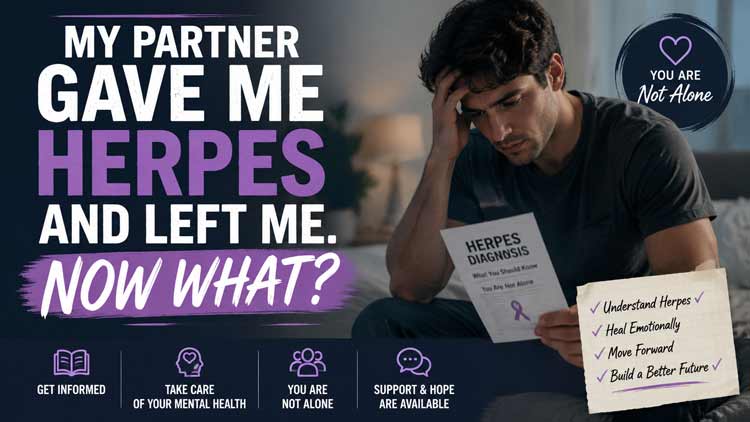
Many people describe this combination of events as one of the darkest moments of their lives. It is common to wonder whether anyone will ever love you again, whether your dating life is over, or whether you'll ever stop replaying everything that happened. Some even question whether they deserved what happened or blame themselves for trusting someone they cared about.
If this describes your situation, know that your emotional response is completely understandable. Losing a relationship is painful by itself. Receiving an HSV diagnosis can be emotionally overwhelming. Experiencing both together often creates a level of grief that few people around you fully understand.
The good news is that while your life has changed, it is far from over. Thousands of people every day recover emotionally, rebuild their confidence, develop healthy relationships, and eventually realize that herpes became only one small part of their story—not the ending.
Why This Situation Hurts So Much
Being diagnosed with herpes after a breakup is more than simply dealing with a virus. It often feels like multiple losses happening simultaneously.
You may feel betrayed because someone you trusted exposed you to an infection that stays with you for life. You may also grieve the relationship itself, especially if you imagined building a future together. At the same time, you suddenly have to learn about herpes, process frightening information from the internet, and wonder how future partners will react.
This emotional overload often causes people to catastrophize. Thoughts like "No one will ever want me," "My life is ruined," or "I'm damaged forever" become common during the first few weeks after diagnosis.
Psychologists recognize this as a natural response to trauma. When several stressful events happen at once, the brain temporarily assumes the worst-case scenario in an attempt to protect itself from future pain.
Fortunately, those thoughts rarely reflect reality.
It's Normal to Feel Angry
Anger is one of the strongest emotions after discovering that a former partner transmitted herpes. Some people are furious because their partner knowingly withheld their diagnosis. Others become angry because their partner denies responsibility, shifts blame, or simply disappears after the diagnosis.
You may replay conversations repeatedly.
You may wonder whether they lied.
You may question every memory from the relationship.
These reactions are common.
Anger itself isn't unhealthy. The challenge comes when anger becomes the only emotion you allow yourself to feel. Remaining trapped in resentment gives your former partner continued control over your emotional well-being long after the relationship has ended.
Healing doesn't require forgiving what happened immediately. It simply means refusing to let their actions determine your future forever.
Did They Know They Had Herpes?
One of the most painful unanswered questions is whether your former partner knowingly transmitted herpes.
The truth is that many people never know.
Herpes is frequently spread by individuals who have no symptoms or have such mild symptoms that they mistake outbreaks for razor burn, ingrown hairs, allergic reactions, or minor skin irritation.
Others genuinely receive a diagnosis only after their partner tests positive.
Of course, there are situations where someone knowingly conceals their infection, and that betrayal can be especially painful.
Without clear evidence, however, it is often impossible to know which situation occurred. Spending months trying to solve an unsolvable mystery rarely brings closure.
Your healing ultimately depends less on understanding exactly what happened and more on deciding what happens next.
You Are Mourning More Than a Relationship
Many newly diagnosed people believe they are grieving only the breakup.
In reality, they are grieving multiple imagined futures.
You may have pictured marriage, children, vacations together, or growing old with this person. You may also have imagined dating without ever needing to disclose an STI.
Now those expectations suddenly feel shattered.
This grief deserves acknowledgment.
It isn't dramatic.
It isn't weakness.
It is a genuine psychological loss.
Like all grief, it gradually becomes easier to carry.
Herpes Doesn't Define Your Worth
One of the biggest emotional traps after diagnosis is allowing herpes to become your entire identity.
You stop seeing yourself as a teacher, artist, parent, engineer, student, traveler, athlete, or friend.
Instead, your brain labels you as "the person with herpes."
This identity shift often happens because of stigma rather than the virus itself.
Medically speaking, herpes is usually a manageable skin condition. Emotionally, however, public misconceptions make it seem far worse than it actually is.
The truth is that your personality, kindness, intelligence, humor, loyalty, career, hobbies, dreams, and values remain exactly the same person they were before your diagnosis.
The virus changed one aspect of your health.
It did not reduce your value as a human being.
Understanding the Difference Between Reality and Stigma
Much of the fear surrounding herpes comes from social stigma rather than medical reality.
Millions of people worldwide live with HSV-1 or HSV-2. Many never experience noticeable symptoms. Others have occasional outbreaks that become less frequent over time.
Modern antiviral medications can reduce outbreaks while significantly lowering the risk of transmission. Many couples maintain healthy long-term relationships where only one partner has herpes.
Unfortunately, movies, television, and internet jokes have created an exaggerated image of herpes that doesn't match the experiences of most people actually living with it.
Learning accurate medical information often becomes one of the first steps toward emotional recovery.
Should You Tell Future Partners?
One of the biggest fears after being abandoned is imagining future disclosure conversations.
Many people assume every future partner will reject them immediately.
Real life is often very different.
Disclosure is rarely easy, but honesty creates the foundation for healthy relationships. Many people respond with curiosity instead of judgment. Others appreciate the honesty because it demonstrates trust and maturity.
Some relationships do end after disclosure, but many continue successfully.
Rejection happens in dating for countless reasons including personality differences, life goals, timing, attraction, and compatibility.
Herpes is simply one factor among many.
It is not an automatic dealbreaker for everyone.
Dating Again May Feel Impossible—At First
Immediately after diagnosis, dating often feels unimaginable.
You may think no one could possibly accept you.
This feeling is temporary.
As your confidence returns, your perspective usually changes dramatically.
Many people discover that they become more intentional about relationships after diagnosis. Instead of chasing validation, they focus on finding emotionally mature partners capable of empathy, communication, and mutual respect.
Ironically, some people later describe healthier relationships than they experienced before herpes because they developed stronger communication skills through disclosure.
The Importance of Self-Compassion
After diagnosis, your inner voice may become extremely harsh.
You might criticize yourself for trusting the wrong person.
You may blame yourself for not asking more questions.
You may replay every decision repeatedly.
Self-compassion doesn't mean pretending nothing happened.
It means recognizing that you made decisions based on the information you had at the time.
Most people enter relationships expecting honesty from someone they love.
Trust is not stupidity.
It is a necessary part of healthy relationships.
When Depression Follows Diagnosis
Temporary depression is unfortunately common after an HSV diagnosis combined with a painful breakup.
You may lose interest in activities you once enjoyed.
Your appetite may change.
You may have trouble sleeping or find yourself sleeping excessively.
Concentration may become difficult.
If these symptoms continue for several weeks or begin interfering with your ability to function, speaking with a mental health professional can make an enormous difference.
Therapists regularly help clients process relationship trauma, betrayal, grief, and chronic health diagnoses. You do not have to carry this burden alone.
Finding Community Can Change Everything
Many newly diagnosed individuals isolate themselves because they believe no one could possibly understand what they're experiencing.
Ironically, connecting with others living with herpes is often one of the fastest ways to reduce shame.
Whether through support groups, educational communities, or herpes-focused dating platforms, hearing real stories helps replace fear with perspective.
You quickly discover people who have been happily married for decades, raised families, enjoyed fulfilling careers, and maintained active social lives despite their diagnosis.
Their stories challenge the catastrophic beliefs that often dominate the early weeks after diagnosis.
You Are Allowed to Move On
Sometimes people feel guilty about eventually becoming happy again.
They believe moving forward somehow minimizes what happened.
It doesn't.
You can acknowledge the pain while still creating a meaningful future.
You can recognize betrayal without allowing it to define your identity.
You can carry difficult memories while continuing to build joyful ones.
Healing is not forgetting.
Healing is learning that your future deserves more attention than your past.
If You Still Love the Person Who Left
One of the most confusing emotional experiences is continuing to love someone who hurt you deeply.
Love does not disappear overnight simply because someone behaved poorly.
You may miss the relationship while simultaneously feeling angry.
You may want answers while also fearing contact.
These conflicting emotions are completely normal.
Give yourself permission to experience them without judging yourself.
Eventually, emotional clarity usually arrives as distance grows.
You begin seeing the relationship more realistically instead of only remembering the good moments.
Your Future Relationships Can Still Be Beautiful
Many people eventually meet partners who respond to their herpes disclosure with compassion instead of rejection.
Some already have HSV themselves.
Others simply recognize that every person carries some form of vulnerability.
The strongest relationships are rarely built on perfect health.
They are built on honesty, kindness, emotional safety, and mutual respect.
Those qualities remain fully available to you.
Your diagnosis has not taken away your ability to love or be loved.
What Healing Actually Looks Like
Healing rarely happens all at once.
At first, you may think about herpes every hour.
Then every day.
Eventually, some days pass without thinking about it at all.
Your first disclosure will likely be frightening.
Your second may be easier.
Your confidence gradually returns through experience rather than wishful thinking.
Months from now, you may look back and barely recognize the terrified person you were immediately after diagnosis.
That transformation happens for countless people every year.
There is every reason to believe it can happen for you as well.
Final Thoughts
If your partner gave you herpes and then left, it may feel like you've been abandoned twice—once emotionally and once physically. The heartbreak is real, the grief is real, and the uncertainty about the future is real.
But so is recovery.
Herpes does not erase your worth, your attractiveness, your intelligence, your kindness, or your ability to build meaningful relationships. It does not sentence you to lifelong loneliness. It does not define your future.
One day, this chapter may become something you speak about with surprising strength rather than overwhelming pain. The relationship may end up teaching you the importance of honesty, boundaries, resilience, and choosing partners who genuinely value you.
Your former partner's decision to leave says far more about them than it does about you.
Your story did not end with a diagnosis. It simply entered a chapter you never expected. With time, accurate information, emotional support, self-compassion, and hope, many people discover that the life they feared losing slowly becomes a life they genuinely enjoy again.
How to Stop Blaming Yourself
After a herpes diagnosis, especially one that follows a painful breakup, many people become their own harshest critic. They replay every conversation, every date, and every intimate moment looking for the point where they believe they "should have known better." This self-blame can become more painful than the diagnosis itself.
The reality is that relationships require trust. Most people do not ask every partner to provide complete medical records before becoming emotionally involved. People rely on honesty, communication, and mutual respect. If your former partner knowingly withheld information, that decision belongs to them—not to you. Even if they didn't know they carried HSV, contracting herpes is not evidence that you were careless or irresponsible. It is evidence that you were human.
Sexually transmitted infections are incredibly common. Millions of responsible, educated adults contract herpes despite taking precautions. Condoms reduce risk but cannot eliminate it because herpes spreads through skin-to-skin contact. Many transmissions occur when no symptoms are present, making prevention more challenging than many people realize.
Instead of asking yourself, "Why did this happen to me?" try asking, "What can I do to take care of myself now?" That shift moves your attention away from guilt and toward healing.
Learning About Herpes Can Reduce Anxiety
One of the biggest reasons people experience overwhelming anxiety after diagnosis is misinformation. The internet is full of frightening stories, outdated statistics, and misleading discussions that paint herpes as a life sentence of constant outbreaks and rejection.
For many people, the reality is much less dramatic. Initial outbreaks can be uncomfortable, but future outbreaks often become less frequent and less severe over time. Some individuals rarely experience another noticeable outbreak after the first year. Others find that stress management, adequate sleep, healthy habits, and antiviral medication significantly reduce symptoms.
Understanding asymptomatic viral shedding, transmission risks, suppressive therapy, and outbreak triggers can replace fear with realistic expectations. Knowledge does not erase the diagnosis, but it often removes much of the uncertainty that fuels emotional distress.
When you understand what herpes is—and what it is not—you become better equipped to make informed decisions instead of fear-based ones.
The Fear of Being Alone Forever
One of the most common thoughts after a breakup and HSV diagnosis is, "No one will ever choose me again."
This belief feels convincing because your mind is trying to predict the future while you're experiencing intense emotional pain. Unfortunately, emotional pain often convinces us that temporary feelings are permanent facts.
Thousands of people living with herpes marry partners who do not have HSV. Others date people who also have herpes, eliminating concerns about disclosure within the relationship. Many discover that potential partners care far more about honesty, compatibility, and emotional connection than they do about a manageable viral infection.
The dating pool may feel different after diagnosis, but it is far from empty. Healthy relationships continue to begin every day between people living with herpes and partners who accept them exactly as they are.
What Healthy Relationships Look Like After Herpes
Many survivors of difficult relationships eventually notice something unexpected. Herpes changes not only how they date but also who they choose to date.
Instead of chasing people who send mixed signals or avoid commitment, they begin looking for partners who communicate openly, ask thoughtful questions, and demonstrate empathy. Disclosure naturally filters out individuals who lack maturity while drawing attention to those capable of handling difficult conversations with compassion.
This does not mean herpes is a blessing or that the diagnosis was somehow necessary. Rather, many people discover that the experience encourages healthier relationship habits and stronger emotional boundaries.
You may become more selective. You may recognize red flags sooner. You may prioritize honesty over chemistry alone. Those changes can lead to healthier relationships than the one that ended.
Healing Takes Time, Not Perfection
Recovery after betrayal and diagnosis is rarely linear. Some days you'll feel hopeful and optimistic. Other days, a memory, an outbreak, or seeing your ex on social media may trigger sadness all over again.
This doesn't mean you've failed to heal.
Healing is measured by overall progress, not by the absence of difficult days. Over time, the painful moments usually become less intense and less frequent. The diagnosis gradually occupies less mental space, and your identity expands beyond it once again.
Give yourself permission to recover at your own pace. There is no deadline for emotional healing.
You Deserve a Future Bigger Than This Moment
Right now, it may feel impossible to imagine that life will ever feel normal again. But countless people who once felt exactly the same now look back on their diagnosis as one difficult chapter in an otherwise fulfilling life.
They built successful careers. They fell in love again. They got married. They became parents. They traveled, laughed, celebrated milestones, and created memories that had nothing to do with herpes.
Your diagnosis does not determine the quality of the decades ahead. The choices you make from this point forward—seeking support, learning the facts, practicing self-compassion, and remaining open to connection—will have a far greater influence on your future than the virus itself.
If your partner gave you herpes and then left, they may have changed the course of your life, but they did not take away your ability to heal. They did not take away your capacity for love. They did not take away your future.
One day, you may discover that the person you became after surviving this experience is stronger, wiser, and more compassionate than you ever imagined possible. While you would never have chosen this path, you can still choose where it leads.
Rebuilding Trust After Betrayal
One of the hidden consequences of this experience is that it often damages your ability to trust. If someone you loved gave you herpes and then walked away, it's understandable to wonder whether anyone can truly be trusted again. You may become suspicious of future partners or feel anxious whenever someone expresses romantic interest in you.
This reaction is a form of self-protection. Your brain is trying to prevent you from experiencing the same pain again. However, protecting yourself and closing yourself off completely are not the same thing.
Learning to trust again doesn't happen by ignoring what happened. It happens by recognizing that one person's actions do not predict everyone else's behavior. Healthy trust develops gradually through consistent honesty, respect, accountability, and communication. Future partners should earn your trust over time rather than receiving it automatically.
You are allowed to become more discerning without becoming emotionally unavailable.
Should You Stay in Contact With Your Ex?
Many people struggle with whether they should keep talking to the partner who transmitted herpes. Sometimes they hope for an apology. Sometimes they want answers. Sometimes they simply miss the relationship despite everything that happened.
There is no universal answer, but it's worth asking yourself whether continued communication is helping you heal or keeping you emotionally stuck.
If every conversation leaves you feeling blamed, manipulated, guilty, or confused, creating distance may be the healthiest choice. Closure doesn't always come from another person's explanation. Often, it comes from accepting that you may never receive the apology or accountability you deserve.
Your healing should not depend on someone else's willingness to acknowledge the harm they caused.
How Friends and Family May Respond
Deciding whether to tell friends or family about your diagnosis is deeply personal. Some people choose to confide in one trusted person, while others prefer to keep their diagnosis private.
Unfortunately, not everyone understands herpes. Some people may unintentionally repeat outdated myths or make insensitive comments simply because they lack accurate information. Others may surprise you with compassion and unconditional support.
If you choose to share your diagnosis, consider starting with someone who has consistently demonstrated empathy and discretion. Having even one supportive person in your corner can make a tremendous difference during recovery.
Remember that your medical information belongs to you. You are never obligated to disclose your diagnosis to friends, coworkers, or extended family simply because they ask questions.
Managing Outbreaks Without Letting Them Control Your Life
For many people, the first outbreak is the most physically uncomfortable. Over time, outbreaks often become shorter, milder, and less frequent as the immune system responds more effectively to the virus.
Learning your personal triggers can also help. Some people notice outbreaks after periods of intense stress, illness, lack of sleep, or physical exhaustion. Others experience very few recurrences regardless of lifestyle.
Working with a healthcare provider can help you determine whether episodic treatment or daily suppressive antiviral medication is appropriate for your situation. Good medical care can reduce both symptoms and anxiety by giving you a clear management plan.
The goal is not to pretend herpes doesn't exist. The goal is to keep it from becoming the center of your life.
You Are More Than Someone's Mistake
When a former partner leaves after transmitting herpes, it's easy to feel as though your entire future has been determined by someone else's decision. But while you cannot change what happened, you still have control over how your story continues.
You are not defined by one relationship.
You are not defined by one diagnosis.
You are not defined by someone else's dishonesty, fear, or inability to take responsibility.
You are still capable of building meaningful friendships, pursuing career goals, exploring new opportunities, falling in love, and experiencing joy. The diagnosis may influence certain conversations and decisions, but it does not erase the countless other parts of your identity.
From Surviving to Thriving
In the beginning, your goal may simply be to make it through each day. That's enough. Healing starts with very small steps: attending medical appointments, learning accurate information, talking with someone you trust, eating regular meals, sleeping when you can, and reminding yourself that your emotions will not always feel this overwhelming.
As weeks turn into months, you'll likely notice subtle changes. You may laugh more often. You may go several days without thinking about herpes. You may realize that the breakup hurts less than it once did. These moments are signs of recovery, even if they seem small.
Eventually, many people reach a point where herpes becomes something they manage rather than something that manages them. They stop measuring their future by their diagnosis and begin measuring it by the relationships they build, the experiences they enjoy, and the life they continue creating.
Conclusion
If your partner gave you herpes and then left, it's understandable if you feel heartbroken, angry, frightened, or overwhelmed. Those emotions reflect the significance of what you've experienced, but they do not predict your future.
Herpes is a common and manageable condition, and a breakup—even one involving betrayal—is not the final chapter of your life. With time, reliable medical information, emotional support, and self-compassion, the intense pain you feel today will almost certainly soften.
You deserve relationships built on honesty rather than secrecy, respect rather than manipulation, and acceptance rather than shame. The right people will see your diagnosis as one small part of who you are, not your defining characteristic.
Today, your world may feel smaller than it did before. But as healing unfolds, you'll likely discover that your future is still filled with opportunities for love, connection, purpose, and happiness. What happened to you is part of your story, but it is not the ending. It is simply the beginning of a new chapter—one in which you have the power to write the rest.